








The 5 Hidden Poisons in Your Daily Diet
 March 27, 2026
The 5 Hidden Poisons in Your Daily Diet (And Why They Are Worse Than Sugar)
We all know that consuming too much refined sugar is harmful to our health, but what if there are ingredients far more dangerous hiding in your daily meals? [1] Everyday items like biscuits, peanut butter, instant noodles, and even “healthy” snacks are packed with chemicals that are heavily restricted or outright banned in countries across Europe and America, yet widely consumed in India. [1, 2]
If we rate the toxicity of refined sugar as a 5 out of 10, the following five ingredients score significantly higher. [3] Here is a breakdown of the five most dangerous ingredients secretly destroying your health, acting as slow poisons in your body [4].
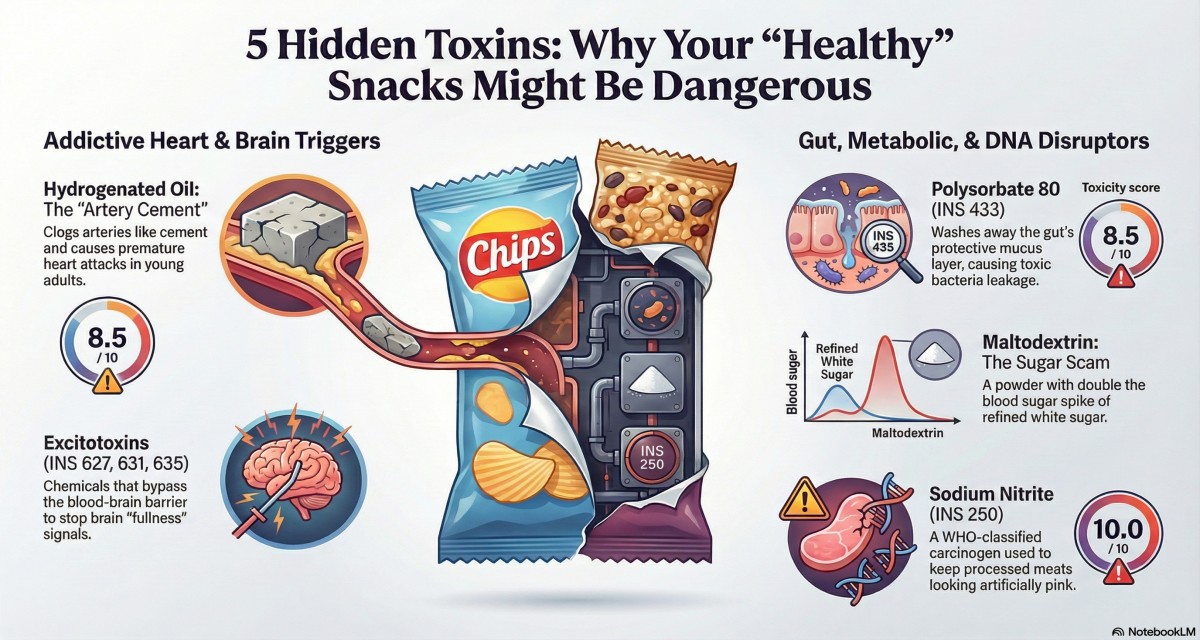
1. Hydrogenated Oil (Toxicity Score: 8.5/10)
What it is: Commonly known as Dalda or Vanaspati, hydrogenated oil is created by mixing cheap vegetable oil with hydrogen gas in a lab, turning it into a hard, solid fat. [5] It was originally invented to make cheap candles and soaps, not for human consumption. [5]
Where it hides: You will find it in popular biscuits ,movie theater popcorn, packaged butter popcorn, and even peanut butter (used to prevent oil separation). [1, 2, 5] It is often disguised on ingredient lists as “edible vegetable fat.” [3]
The Danger: This lab-made ingredient acts like cement inside your heart’s blood vessels. [5] It is a major trigger for premature heart attacks, specifically in young, fit individuals with no family history of heart disease. [3] While sugar makes you gain weight, hydrogenated oil directly blocks your heart. [2] It is so deadly that the World Health Organization (WHO) is campaigning to eliminate it globally, and it is banned in the US, Canada, Singapore, and Saudi Arabia. [2, 3]
2. INS 627 and INS 631: The Brain Hijackers (Toxicity Score: 8/10)
What it is: After the massive public backlash against MSG in 2015, food companies simply replaced it with two new flavor-enhancing chemicals: INS 627 and INS 631 (sometimes combined as INS 635). [6, 7]
Where it hides: They are heavily used in savory snacks and even products marketed as “healthy” like masala Oats, flavored makhana, and soya sticks. [7]
The Danger: These chemicals are “excitotoxins” that bypass the blood-brain barrier and hack your taste buds so your brain forgets to signal that your stomach is full. [6] This is why you cannot stop eating after opening a packet of chips. [2, 8] Worse, these chemicals dangerously spike uric acid levels in the body, leading to acute gout attacks and painful acid crystals in the joints. [7]
3. Polysorbate 80 / INS 433: The Gut Washer (Toxicity Score: 8.5/10)
What it is: Polysorbate 80 is a chemical emulsifier used to force oil and water to mix together. [8]
Where it hides: It is commonly found in ice creams (like Vadilal, Havmor, and Baskin Robbins), packaged coconut milk, and liquid spice extracts. [1, 9]
The Danger: Top medical journals have proven that when INS 433 enters your stomach, it acts exactly like dish soap. [8, 9] It literally washes away the thin, protective mucus layer in your intestines. [9] This leads to Leaky Gut Syndrome, where toxic stomach bacteria leak directly into your bloodstream. [9] It is banned in European organic foods and restricted in infant foods by the WHO. [10]
4. Maltodextrin: The “Sugar-Free” Scam (Toxicity Score: Highly Dangerous to Diabetics)
What it is: A cheap, lab-made powder used as a filler in artificial sweeteners like Splenda and Sugar Free Natura. [10] Thanks to a legal loophole known as the “Five Calorie Rule,” brands can legally label a product “Zero Calorie” if a serving has less than five calories. [10, 11]
Where it hides: Artificial sweeteners, Britannia NutriChoice digestive biscuits, health drinks like Bournvita, instant noodles, and oats. [11]
The Danger: Companies label products containing maltodextrin as “No Added Sugar” because the food authority (FSSAI) categorizes it as a carbohydrate, not a sugar. [11] However, while regular sugar has a Glycemic Index of 65, Maltodextrin has a massive Glycemic Index of 136. [11] It spikes blood sugar twice as fast as normal sugar, acting like a “sugar bomb” in the bloodstream. [11] Furthermore, harmful bacteria like E. coli and Salmonella easily stick to maltodextrin in the gut, making it a major contributor to Irritable Bowel Syndrome (IBS) and Irritable Bowel Disease (IBD). [12]
5. Sodium Nitrite / INS 250: The Pink Poison (Toxicity Score: 10/10)
What it is: A cosmetic poison used by the food industry to stop old, processed meat from rotting and to give it an artificial, fresh pink color. [4, 13]
Where it hides: Packaged salami, hot dogs, and sausages from large brands. [13]
The Danger: The WHO has declared INS 250 a Group 1 Carcinogen, placing it in the exact same danger category as tobacco, asbestos, and plutonium. [13] When this chemical mixes with stomach acid or is cooked at high heat, it forms nitrosamines—potent chemicals that mutate your DNA and cause stomach and bowel cancers. [14] In the medical field, it is known as an “oxygen blocker.” In high doses, it stops the blood from carrying oxygen, turning healthy red blood dark brown and suffocating the body from the inside. [14] Just 50 grams of processed meat daily increases your cancer risk by 18%. [14]
The Bottom Line:
These chemicals do not make you immediately sick, which is why they are legally allowed in the food industry; instead, they slowly accumulate in your system over time. [4] Take control of your health by reading ingredient labels carefully. [4, 8] If you see hydrogenated oils, INS 627, 631, 635, 433, Maltodextrin, or INS 250, throw the product in the dustbin and prioritize fresh, home-cooked food instead. [4, 8]
This article is for informational purposes only and is not medical advice.
follow worldwire for latest updates.