
Key Contents :
Can Your Teeth Actually Heal Themselves? The Science of Remineralization
We’ve all been there: sitting in the dentist’s chair, dreading the news that a new cavity has formed. For decades, we’ve been led to believe that once a tooth starts to decay, the only solution is to drill it out and fill it with artificial materials. However, modern dentistry reveals a much more empowering truth: while your teeth cannot spontaneously regrow, they absolutely can heal themselves through a process called remineralization [1].
If you suffer from cold sensitivity or have noticed matte white spots on your teeth—the classic early warning signs of a cavity—you are in the perfect window to reverse the damage [2]. Here is the fascinating science behind how your teeth break down, and the four-step formula you can use to naturally heal them.
The Root Cause: It’s All About Acid
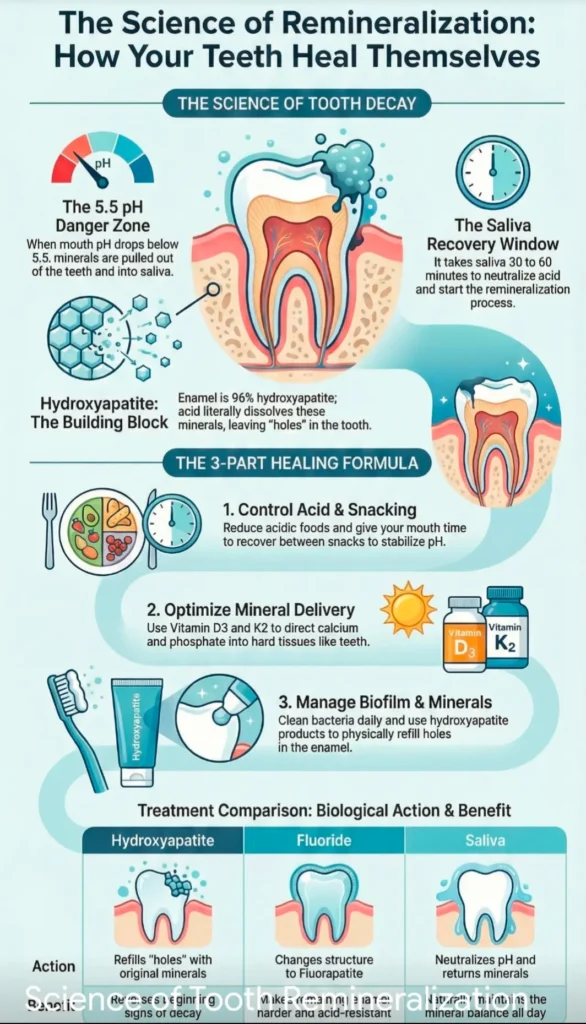
To understand how to heal a tooth, you first must understand how it gets damaged. Our teeth are composed of 96% minerals, primarily a crystalline structure of calcium and phosphate known as hydroxyapatite [3]. The remaining 4% consists of water and organic materials [3].
Cavities do not just magically appear; they are the direct result of acid [1]. When the pH level in your mouth drops to 5.5 or lower, an acidic environment is created [1]. This acid acts like a solvent, literally pulling the calcium and phosphate minerals out of your tooth enamel and dissolving them into your saliva [1, 3]. This leaves microscopic holes in the enamel matrix [4].
This destructive acid comes from two primary sources:
- Dietary Acids: Foods and beverages like soda, energy drinks, lemons, pineapples, and even tomatoes are inherently acidic and immediately begin dissolving tooth minerals upon contact [3].
- Bacterial Acid: When you consume sugary foods, the bacteria living in your mouth’s biofilm feed on those sugars [5]. It isn’t the sugar itself that directly rots your teeth; it is the fact that these bacteria excrete acid as a byproduct of digesting the sugar [5].
This constant drain of minerals is called demineralization [6]. Fortunately, your body has a built-in defense mechanism to reverse it, provided you give it the right tools.
The Four-Step Formula to Remineralize Your Teeth
Healing your teeth means putting those lost minerals back into the microscopic holes left behind by acid attacks [6, 7]. You can actively encourage this remineralization process by following a simple four-part strategy [1]:
1. Manage the Acid Attacks
Your saliva is your mouth’s natural healing agent, but it takes 30 to 60 minutes for saliva to neutralize the acid and return your mouth to a safe pH after you eat or drink [4]. If you are constantly snacking or sipping on beverages throughout the day, your mouth remains in a chronic state of acidity, and your saliva never gets the chance to replace the lost minerals [4]. To stop demineralization, minimize how often you eat [4]. Try replacing your mid-morning snack with a simple glass of water to give your mouth the recovery time it desperately needs [4, 8].
2. Optimize Your Saliva with the Right Minerals and Vitamins
Every time you eat and your pH drops, minerals are pulled into your saliva and swallowed [5]. If your body is well-nourished, your saliva will naturally bring fresh minerals back to the teeth to neutralize the acid and repair the enamel [5]. However, simply consuming calcium and phosphate isn’t enough; you need the right “traffic directors” to guide those minerals [8].
Vitamin D3 is essential because it makes calcium available in the body, while Vitamin K2 directs those minerals specifically into “hard tissues” like your teeth and bones [8]. Without Vitamin K2, calcium can dangerously accumulate in “soft tissues,” leading to kidney stones, gallstones, or calcified plaque in your arteries [6, 8].
3. Control the Biofilm
Because bacteria repopulate in your mouth every two to three hours, keeping your teeth physically clean is vital [9]. It is less about whether you have “good” or “bad” bacteria, and more about consistently removing the bugs that feast on sugar and excrete enamel-destroying acid [9]. Brushing and flossing daily disrupt this biofilm, drastically reducing the amount of localized acid on your teeth [9].
4. Practice Conscious Eating
Combine the previous steps by being mindful of what you put in your body. Reduce the frequency of your meals, limit foods with high acid and sugar content, and ensure your diet is rich in essential minerals [7].
The Missing Link: Hydroxyapatite vs. Fluoride
When attempting to heal a cavity, the products you use matter immensely. For years, fluoride has been the standard recommendation. Fluoride works by chemically altering your tooth structure, changing natural hydroxyapatite into a new substance called fluorapatite [10]. While fluorapatite is harder and more resistant to future acid attacks, it does not actually refill the holes or heal the lost enamel [10].
In contrast, hydroxyapatite toothpaste acts as a direct mineral replacement [10]. Because hydroxyapatite is the exact mineral your teeth are already made of, using it literally puts the missing minerals right back into the empty enamel crystals [6, 10]. Research shows this can effectively reverse the beginning stages of tooth decay, transforming porous, sensitive white spots back into glossy, healthy enamel [2, 10].
Conclusion
You are not doomed to a lifetime of drilling and filling. By controlling dietary acids, minimizing snacking to give your saliva a break, supplementing with Vitamin D3 and K2, and utilizing revolutionary hydroxyapatite products, you can successfully put minerals back into your teeth and maintain a naturally healthy, pain-free smile for life [6, 11].
Disclaimer:
This video is for educational purposes only and is not intended to diagnose, treat, cure, or prevent any disease. Always consult with a qualified healthcare professional regarding your individual needs.
Follow worldwire